
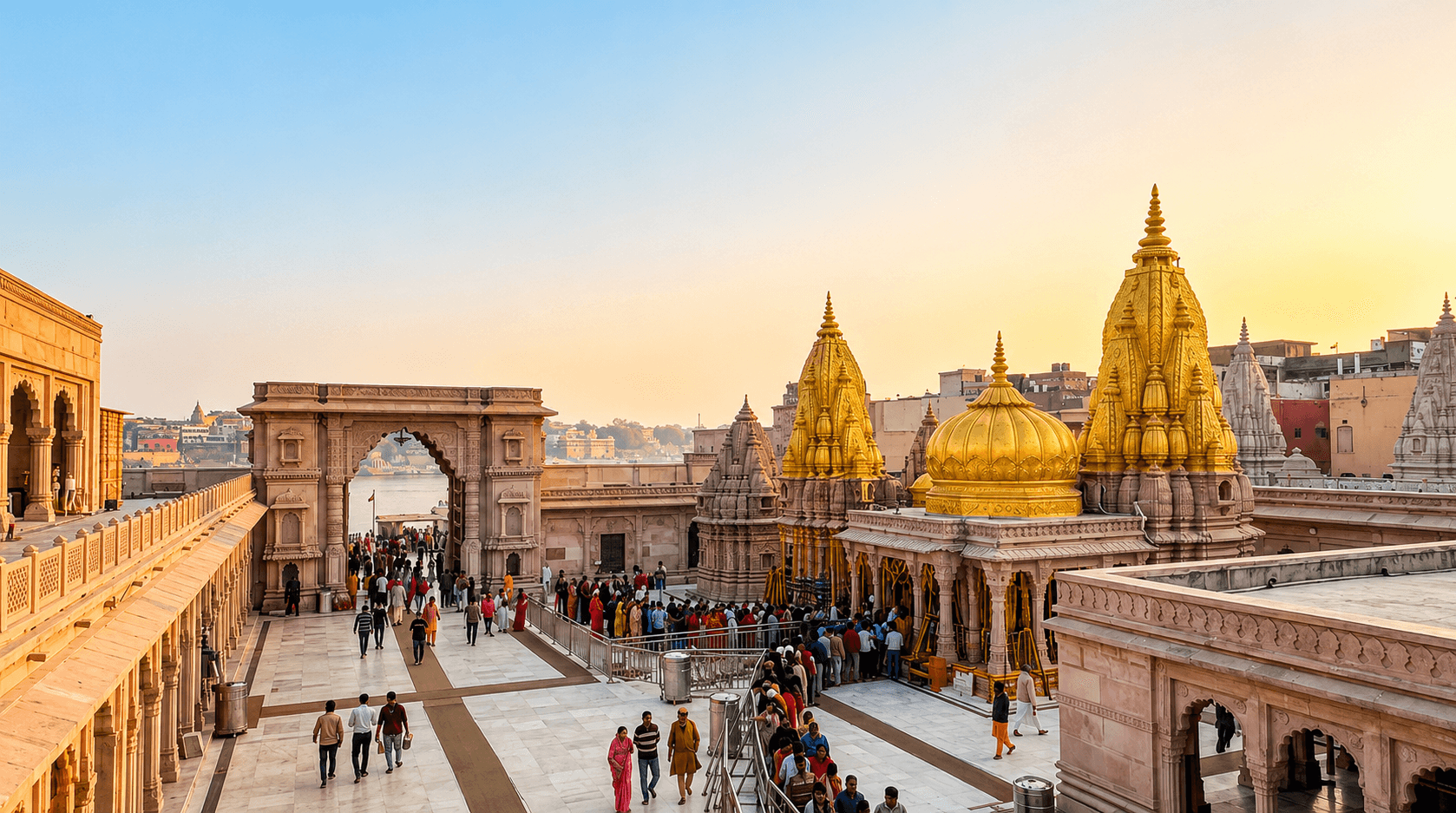
The first Monday of Sawan changes Varanasi completely. By 4 AM, the lanes leading to Kashi Vishwanath Temple are already packed—priests carrying milk offerings, pilgrims chanting Har Har Mahadev, and vendors setting up flower stalls in the darkness before dawn. This is Sawan in Varanasi, and if you are planning to experience it, knowing what to expect—and where to stay—makes all the difference.
Sawan, the holy month dedicated to Lord Shiva, falls between mid-July and mid-August on the Hindu calendar. For Kashi Vishwanath Temple, it is arguably the busiest and most spiritually significant season of the year. Thousands of Kanwariyas and pilgrims pour into the city every Monday (Sawan Somwar), turning Varanasi's ghats and temple corridors into rivers of devotion. Navigating that experience well requires planning well beyond just buying a train ticket.
When Sawan Happens in Varanasi — Dates & What Changes
In 2026, Sawan begins on 11 July and ends on 9 August. Every Monday within this period—four Sawan Somwars—sees the heaviest crowds at Kashi Vishwanath Temple. But even on regular Sawan days, footfall at the temple runs significantly higher than normal months
The city's entire rhythm shifts during this period. Auto-rickshaw fares go up. Inner lanes near the temple corridor fill by 6 AM. Shops and flower stalls open before sunrise. The Ganga Aarti at Dashashwamedh Ghat—already a spectacle on normal days—becomes a full ceremony attended by thousands standing shoulder to shoulder on the ghat steps.
Sawan Somwar vs Regular Sawan Days
Sawan Somwars (Mondays) are when the difference is most stark. Temple queues for Jal Abhishek can stretch to four or five hours. If you are visiting specifically for the ritual of offering water to the Shivling, a Monday requires either arriving before 4 AM or joining the queue by 5:30 AM at the latest. Tuesday through Sunday within Sawan is easier—quieter than Mondays by a significant margin, though still busier than non-Sawan months.
Best Time to Visit Kashi Vishwanath During Sawan
Early mornings consistently give you the most meaningful experience. The temple opens at 3 AM for Mangala Aarti, and getting inside between 3 AM and 5 AM—especially on non-Monday days—is far less crowded than mid-morning. By 9 AM, the queues have multiplied and the heat makes the wait significantly harder Evening is the other window worth targeting. Saptarishi Aarti happens at 7 PM inside the temple complex, and the Ganga Aarti at Dashashwamedh Ghat begins around 7 PM as well. The ghats look completely different in the evening—oil lamps, brass diyas, and incense smoke rising over the river as the sun drops below the far bank
Temple Timings at Kashi Vishwanath (Sawan Season)
Mangala Aarti: 3:00 AM – 4:00 AM
Darshan opens: 4:00 AM onwards
Peak crowd window: 9:00 AM – 12:00 PM (avoid if possible on Mondays)
Afternoon break: 12:00 PM – 4:00 PM (partial access)
Evening Darshan: 4:00 PM – 11:00 PM
Saptarishi Aarti: 7:00 PM
What to Expect Inside the Kashi Vishwanath Corridor
The Kashi Vishwanath Corridor, inaugurated in 2021, reorganised the approach to the temple significantly. You now enter from a single main corridor, pass through security, and reach the sanctum through a structured path. Locker facilities are available near the entrance for bags, phones, and other belongings—the temple prohibits mobile phones and certain items inside
During Sawan, the Jal Abhishek ritual—pouring water from the Ganga on the Shivling—draws the heaviest queues. If this is the central purpose of your visit, budget three to four hours minimum on a Sawan Somwar. Carry water from Dashashwamedh Ghat if possible; it carries extra significance for pilgrims, though pre-packaged Gangajal is sold near the entrance as well. One thing many visitors overlook: the lanes immediately surrounding the temple—Vishwanath Gali, Thatheri Bazaar—are worth at least an hour of exploration. Brass vendors, silk shops, and small sweet shops line these streets, and the sensory contrast between the chaotic commerce and the sacred calm inside the temple is distinctly Varanasi
How to Get Around Varanasi During Sawan
Varanasi's inner lanes are not designed for heavy vehicles. During Sawan, many streets near the temple corridor are pedestrian-only after 6 AM. The practical approach most experienced pilgrims use: take a cab or auto-rickshaw to the nearest accessible point—usually Godaulia Crossing or Dashashwamedh Road—and walk the final 10 to 15 minutes
Cab from Varanasi Junction area: 15–20 minutes to Godaulia Crossing
Auto-rickshaw: slightly quicker on good traffic days, slightly slower during peak Sawan Mondays
E-rickshaws: available near most major intersections, practical for the stretch from Godaulia to ghat areas
Walking: unavoidable for the last 500–700 metres in any case
Parking near the temple is practically impossible during Sawan. Staying at a hotel with parking facilities—like asar Varanasi Junction in the Chetganj neighbourhood—means your vehicle stays safe at the property while you use cab or auto services for temple visits.
Where to Stay in Varanasi During Sawan — What Actually Works
The most common mistake first-time visitors make is booking accommodation inside the inner lanes near the temple. Proximity sounds appealing on paper. In practice, during Sawan, those locations mean constant noise through the night, no parking, and streets so narrow that deliveries or emergencies become difficult. Sleep deprivation after the first two nights significantly affects the quality of a pilgrimage.
The more functional approach—particularly for families, couples, and pilgrims staying multiple nights—is a hotel close to Varanasi Railway Station. That places you 12 to 15 minutes by cab from the temple, in a quieter neighbourhood with proper infrastructure, while keeping the spiritual sites fully accessible for multiple daily visits.
Why asar Varanasi Junction Works for Sawan Pilgrims
asar Varanasi Junction by Orion Hotels sits in the Chetganj neighbourhood, 1.9 km from Varanasi Junction railway station and 3.9 km from Kashi Vishwanath Temple. For Sawan visits specifically, several practical features matter:
3 AM temple visit coordination: The 24-hour front desk can arrange early morning cab bookings the night before—critical for Sawan Somwar Mangala Aarti timings
In-house dining: The multi-cuisine restaurant covers breakfast, lunch, and dinner. After a 3 AM wake-up and a four-hour temple queue, returning to a meal that doesn't require navigating unfamiliar streets matters
Air-conditioned rooms: Recovery between visits. Sawan pilgrimage often involves two temple visits per day—morning and evening. A cool, quiet room between them changes the experience completely
The property has three room categories—Standard Double, Deluxe Double, and Premium Double— covering solo pilgrims, couples, and families. One child below 8 years stays free. Book directly at theorionhotels.com for the lowest guaranteed rate, which beats all major OTAs.
Beyond the Temple: Varanasi During Sawan
Varanasi rewards visitors who slow down. The ghats—there are 84 of them along the Ganga—each carry a distinct character. Dashashwamedh is the grand stage. Assi Ghat in the south is calmer, popular with locals for morning yoga and evening sitting. Manikarnika, the cremation ghat, operates continuously and is considered among the most sacred sites in the city.
The boat ride at dawn—available from most major ghats for roughly ₹200 to ₹500 per person depending on the boat and duration—gives you the full panorama of Varanasi from the river. In Sawan, the light over the ghats at 5:30 AM, with temple bells still audible across the water, is the kind of thing people come back to Varanasi for repeatedly Baati Chokha, a simple UP dish of roasted wheat bread, brinjal, and potato mash, is widely available near the ghats and is exactly the kind of uncomplicated, filling meal that works well between early morning and evening temple visits. The area near Kailash Tea Stall, just 10 metres from asar Varanasi Junction, serves authentic local chai—the kind of detail that matters after a long day on your feet.